Guidance Notes
AI Adoption, AI Absorption and AI-First Business Models
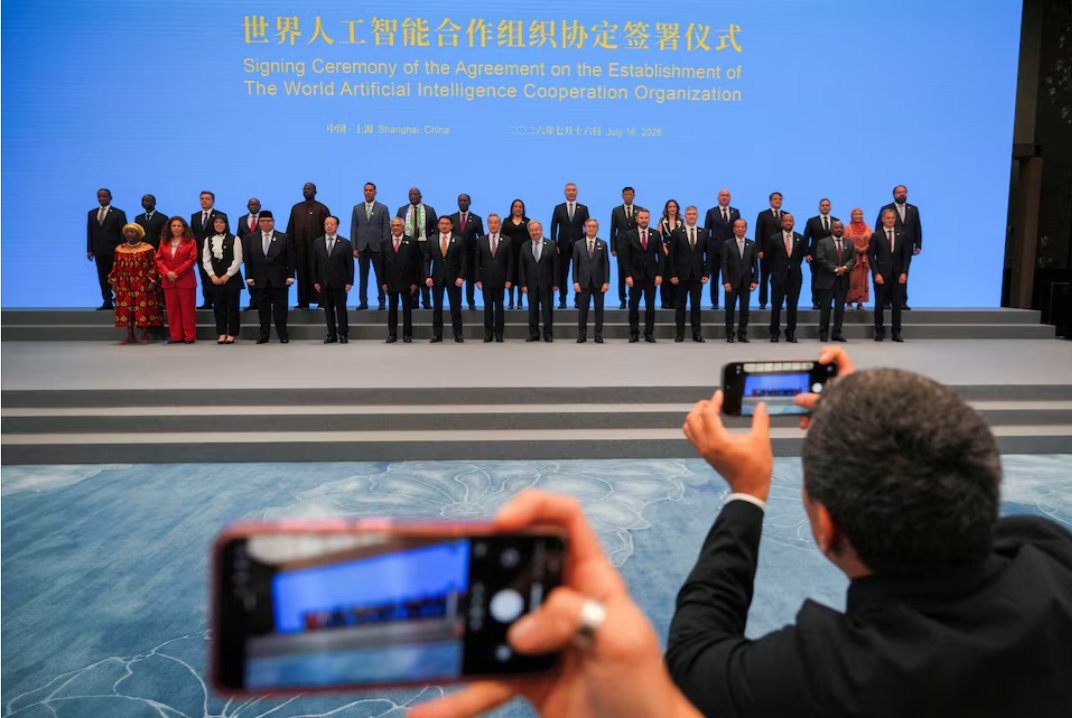
Our technology and research faculty prepared three Guidance Notes earlier this month, addressing how an organisation moves from individual AI use to a structured AI absorption in its business model. The CEO's AI Adoption Playbook sets out the adoption process from experimentation to piloting as a pre-requiste for full scale deployment. The AI-First Business Model Playbook explains how companies can align products, pricing and operating model once intelligence is ready to scale. The third, Safe, Responsible, and Effective Use of AI at Work sets a minimum governance standard for staff use of AI tools, with templates covering organisations from small NGOs to multinational corporations.
Guidance Note No. 2318339
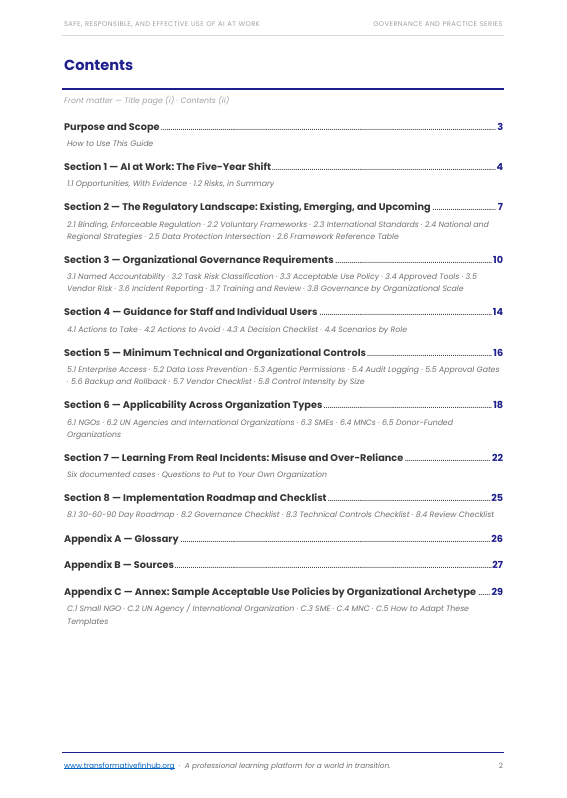
Safe, Responsible, and Effective Use of AI at Work
A practice guide for organisational leaders, from small NGOs to multinationals.
This guide sets a minimum, adoptable standard for how staff use AI tools at work, covering organisations from two-person charities to multinationals with twenty thousand employees. It maps binding and voluntary regulation, sets out named-accountability and risk-classification requirements, gives staff a decision checklist and role-based scenarios, and specifies minimum technical controls from data-loss prevention to agentic permission limits. Section 7 reviews six documented cases of AI misuse and over-reliance, and Appendix C provides four Acceptable Use Policy templates for small NGOs, UN agencies, SMEs and multinationals, with notes on adapting each.
Guidance Note No. 2318330
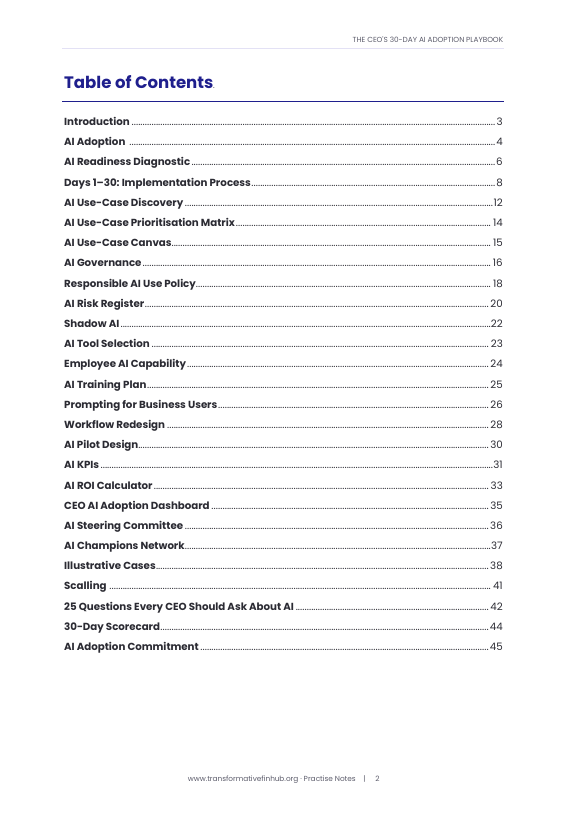
The CEO's AI Adoption Playbook
A day-by-day guide from AI experimentation to a governed, measured programme.
Enterprise surveys put AI use in at least one business function at 88 percent of organisations, yet PwC's 2026 CEO survey of more than 4,000 executives found only 12 percent had achieved both a revenue gain and a cost reduction from it. This playbook sets out a day-by-day route from that gap to a governed programme: an AI readiness diagnostic, a use-case prioritisation matrix, a responsible-use policy and risk register, pilot design and KPI templates, and a 30-day scorecard, closing with a 90-day scaling decision. It is written for organisations without a dedicated AI team or a large technology budget.
Guidance Note No. 2318331
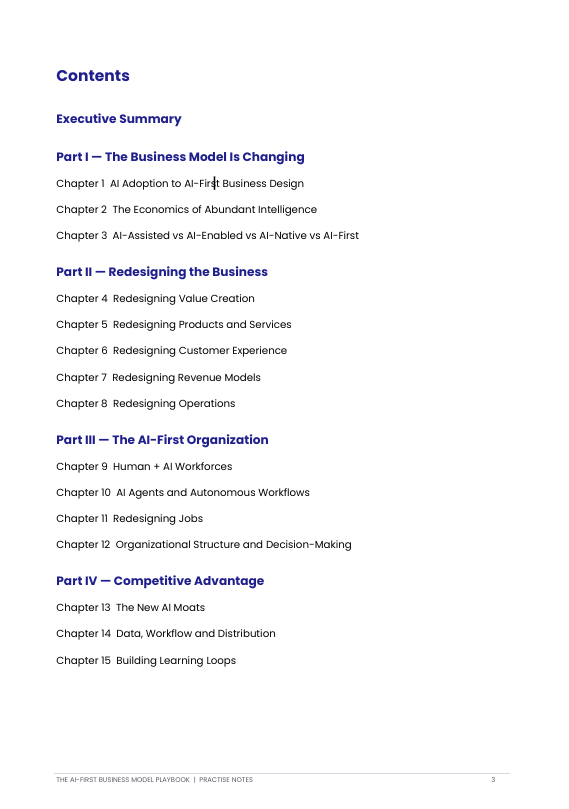
The AI-First Business Model Playbook
How companies redesign products, services and operations around AI.
McKinsey's 2025 State of AI survey of nearly 2,000 organisations across 105 countries found that 88 percent now use AI in at least one function, yet only around 6 percent report an enterprise-level EBIT impact of 5 percent or more. This playbook works through the redesign question behind that gap, distinguishing AI-assisted, AI-enabled, AI-native and AI-first business models, then applying the distinction to value creation, products, customer experience, revenue models and operations. It closes with a 90-day transformation roadmap, a fillable business model canvas, an opportunity scorecard and a job-redesign matrix.
Loading document…
Continue reading
Thank you for your support
You've reached the end of the free 10-page preview. Become a member and get lifetime unlimited access to this note and our full licensed e-library.
One-time subscription — USD 9.99Already a member? Enter your membership number.
Membership number not recognised. Please check the number and try again.
Forgotten your membership number? Contact e-library@transformativefinhub.org for support.